Showing posts with label strategies. Show all posts

Thursday, 26 July 2018

English Language Learners


We have all had new students join our classrooms who are ELL. There are many strategies that educators can do to help the student gain confidence in their new language. Please ensure you check the additional resources I have included at the end of the post that you can use in your classroom to help you plan effective lessons.

There are a lot of things that you can do in your classroom to help ensure your ESL student is successful in gaining a stronger understanding of English.
  • Label items in your classroom with pictures and the word, and possibly with the first language of your ELL. 
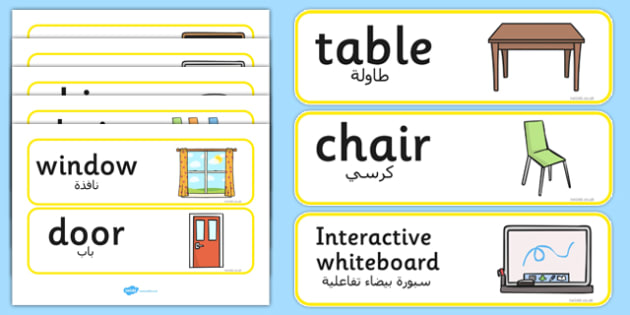
Classroom Furniture Labels Arabic Translation - information, tags, objects, data, everyday, school, class, tables, chair, board, ks1, ks2, early years

  • Provide your student with a personal dictionary with high-frequency words that allows them to reference as needed. Again, this should be something that should include both English and the student's first language.
Image result for english arabic student dictionaryRelated image                      Related image               
  • Pair up your ELL student with someone else in the class who also understands their first language. This provides stability and confidence to the new language learner. With this grouping, the students can think-pair-share together, which will allow the ELL student to know that their ideas matter. Of course, they can speak their first language during this activity, if needed. 
  • AS the teacher, provide many formative assessment opportunities that help to facilitate the success of the student.
  • Immerse your student with language as much as possible. Ensure the language is easy enough to ensure the child understands and ask if the child needs clarity on any topic taught.
  • Provide modifications and/or accommodations as needed in all subject areas. Choose few expectations to assess and refer to English as a Second Language and English Literacy Development: A Resource Guide as a great guide written by Ontario's Ministry of Education.
  • Provide regular conferencing with the student to review current work and develop next steps for the student. Keep a portfolio for the student in order to demonstrate the progress the child is making. Praise and recognize improvements in the child's achievement regularly.
  • Work with the student in small guided reading groups and individually. This video shows how guided reading groups work with ELL.


  • ELL need independent or small group work that explicit instruction that focuses on the sounds and symbols of the English language. The video below is an excellent example of this strategy.


  • Allow the child to orally participate in assignments and the teacher can scribe or record his answers. The video above also demonstrates this strategy so that the students can participate in regular classroom activities.
  • Your student, depending on where they are in the continuum, may work with the ESL teacher for more focused development.
  • Provide your student with technology that will help when reading by utilizing online dictionaries and text-to-speech technology.
  • Support the parents of the student by providing local resources to help them develop their language skills as well such as Immigration Waterloo Region. Most regions have resources available to help parents also learn English.


Teaching Reading Basics with Newcomers in older grades


Using Visual Arts when learning English has been shown to be valuable in helping a student express themselves in various mediums.


There are many wonderful resources to utilize online. Some of these include the following links:

https://www.goodreads.com/book/show/768463.Teaching_for_Comprehending_and_Fluency

https://www.scholastic.com/teachers/lessons-and-ideas/

http://www.tumblebooklibrary.com

Many Roots/Many Voices-Supporting English Language Learners in Every Classroom


English Language Learners-ELD and ESL Programs and Services


Boys and Literacy


Boys and Literacy


Over the past decade, boys have been falling behind compared to their female according to Me Read? NoWay! A Practical Guide to Improving Boys’ Literacy Skills (2004) when it comes to reading achievementThe 2008 report State of Learning in Canada: Toward a Learning Future, published by the Canadian Council on Learning, states that in 2004–05,“more boys (13%) than girls (7.5%) exhibited delayed development” in the area of communication skills (p. 18). This is a concern that continues today.

First, we need to address the reasons why boys are reading less than previously. My concerns are that technology, namely video games, is creating a generation of boys that need the increase of adrenaline they feel when playing video games, which is taking away their desire to read as it doesn't create the same adrenaline rush as winning a game. Here is an excellent article from Psychology Today that discusses what happens to a boy when he is playing intense video games. It affects the physiological and psychological well-being of the child. How do we take this intense response and translate it into our classrooms? This article is worth your time. Having said that, the video below addresses 6 reasons boys are not succeeding as well in school as girls. Interestingly, video games are addressed but discuss in many different ideas about their value to boys. Of course, there are great video games we can use in our classrooms that will engage our students to learn.


There are many factors at work that seem to be impacting how boys view themselves as readers, and there are many strategies that we can implement in a classroom to help boys see themselves as readers. As educators, we can make a difference in their future success by implementing these 13 strategies discussed in Me Read, and How! (2008).

Taken from 'Me Read and How! Ontario teachers report on how to improve boys' literacy skills


Where do we start as teachers?

It is important to start by finding out what your students want to read. A simple reading survey throughout the year will give you a snapshot of what you can do to get started. I use a Google Form survey, that is quick and gives me a really strong idea of where each student is in my class. Feel free to copy it for your own use. I would probably add a few more questions to my survey for this year's class.

Once you have the information gathered from the survey, ensure you have the books that all of your students want to read in the classroom. This may also include magazines and newspapers. It is important for teachers to recognize that reading takes many forms. I have fond memories of my son scouring over the sports section every morning before school. He could tell you every statistic of every hockey player, yet, as an adult, he doesn't see himself as a reader. We need to recognize these alternate sources of reading for our students. I always have a local newspaper handy for students to use (not to mention, they are great for 'In the News' types of reading and writing activities).

Allow your students to have body breaks. I used this strategy this year and told the class that if they needed to increase their heart rate, they could grab one of my skipping ropes and skip in the hallway outside my classroom. This provides them with an increase in their heart-rate and adrenaline that would be similar to video games. Some schools I've been to provide bikes and break-away areas for kids to use, while they are still working. These are great activities all schools should offer their students.


The Gender Divide

Taking gender differences into account in the classroom Michael Smith and Jeffrey Wilhelm identify the following gender differences related to literacy that teachers may encounter in their work with individual learners: With respect to achievement: 
• Boys take longer to learn to read than girls do. 
• Boys read less than girls. 
• Girls tend to comprehend narrative texts and most expository texts significantly better than boys do. 
• Boys tend to be better at information retrieval and work-related literacy tasks than girls are. With respect to attitude: 
• Boys generally provide lower estimations of their reading abilities than girls do. 
• Boys value reading as an activity less than girls do. 
• Boys have much less interest in leisure reading than girls do, and are far more likely to read for utilitarian purposes than girls are. 
• Significantly more boys than girls declare themselves to be non-readers. 
• Boys . . . express less enthusiasm for reading than girls do. (Smith and Wilhelm, 2002, p. 10)


Additional Resources:

Reading Rockets-Boys and Books

Guys Read

Boys Literacy

Viewing Guide Feedback-Edugains

Forest of Reading

Differentiated Instruction in Reading


We know that teaching is not 'one size fits all,' but not every teacher may have the knowledge or strategies to fully understand how we teach our students impacts their achievement. Every classroom, in every school around the world, is filled with students who learn differently from one another. It is our due diligence as educators to ensure all of our students have an equitable classroom that allows for all students to achieve success. 


No matter the circumstance, we know that 'One Size Fits All' is never the solution in education!

We know that understanding all of our students' needs is not as easy as this. It is up to us, as educators, to be informed about every student to provide the resources needed for every student.

Each student we teach learns differently and relies on their teacher to provide the proper tools in order to succeed and have equity within the classroom.


The video below is one of the best videos I've seen that uses Hollywood produced movies to show how teachers demonstrate inclusion and differentiated instruction. Below lists all of the ways the video shows how we can ensure our classroom is a welcoming place where students feel equity through the use of differentiated instruction so that all students can be successful.


1. Know your student:
  • Survey your students to find out about their interests, especially in reading
  • Ensure you are fully aware of all accommodations on every IEP in your classroom and utilize them
  • Provide accommodations to students when you see that they are needed to ensure there is equity and allows for student success
2. Build Community:
  • Empower student voice-let them know that what they have to say is important. Use community-building games and community circles to build community in your classroom.
  • Build trust.
  • Let students know that it is a safe space to express ideas.
  • Allow students to challenge by choice
3. Assessment for Learning:
  • Identify individual needs through conferencing and other forms of formative assessment
  • Identify student strengths. Let them know and help them to develop these strengths
  • Use Cloze Method
4. Differentiated Instruction:
  • Content-Use familiar vocabulary
    • Engage prior knowledge, but understand that prior knowledge varies based on life experiences of children
    • Let students select content when possible
    • Use familiar content formats and interesting themes
  • Student Interest
    • Relate content to student interests
    • Demonstrate connections
    • Apply prior knowledge of students' abilities
    • Have different roles for different students
    • Have roles that match interests
  • Classroom Environment
    • Set clear goals and expectations
    • Adjust the physical space of the classroom to suit the needs of the students
    • Teach to different learning styles and 'smarts' such as word smart, kinesthetic, visual, music, etc.
  • Instructional Process
    • Use games and technology
    • Use a variety of tool that will help students plan and organize their thoughts such as graphic organizers, T-tables, speech-to-text and text-to-speech technology, anchor charts
    • Slow release of responsibility-model, share, guided, independent learning
    • Express high expectations of students
    • Student products should reflect the intended outcome (analyze text and research practices)
    • Final products should be able to take on a variety of formats that will help the student to excel
  • Continual Learning
    • Every teacher should participate in ongoing-professional learning-course, workshops, reading pedagogical literature, etc.
    • Learn from our students


Additional Resources: